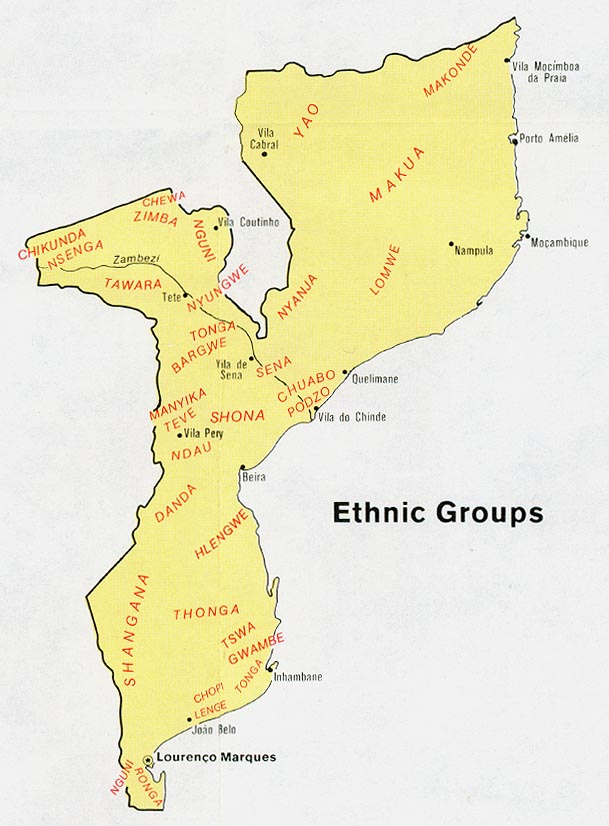
The Dema—also called Madema or Adema—are an indigenous Bantu people of the high, mountainous terrain of Tete Province in northwestern Mozambique. Their heartland is the district of Cahora Bassa, centered on the hilltop village of Songo, the site of Mozambique's largest hydroelectric dam and one of the largest such dams in all of Africa. The Dema share the province with neighboring peoples including the Nyungwe, Angoni, and Chewa, each occupying distinct geographic zones within Tete's great cultural diversity. The Dema language, also called Dema, is a Bantu language in the Shona cluster; a translation of Scripture in Dema has been started but is not yet complete.
The Zambezi River has shaped the history of this region for millennia, serving as a corridor of trade, migration, and conflict between the coast and the interior of southern Africa. The Portuguese established a colonial presence in the Tete region by the seventeenth century, when Tete city was already a market for ivory and gold. An old Catholic mission at Songo itself testifies to early Christian contact with the Dema and their neighbors. David Livingstone reached the Cahora Bassa gorge in the 1850s, noting its enormous economic potential; the name Cahora Bassa comes from a local expression meaning "an end of work," the words Livingstone's guides used when they refused to cross the impassable gorge.
The most consequential rupture in modern Dema history came with the construction of the Cahora Bassa hydroelectric dam, completed by Portuguese engineers in 1974 during the final years of colonial rule. The dam permanently flooded 2,700 square kilometers of productive Zambezi floodplain and forced the resettlement of thousands of people from the valley communities, including Dema families, into government-designated villages. Mozambique gained independence in 1975, and the Cahora Bassa dam was eventually handed over to Mozambican control in 2007.
The Dema are smallholder farmers living in a rugged, semi-arid highland landscape. Their staple crops include maize, cassava, and sorghum—foods grown in small family gardens that depend on seasonal rainfall. The region's hot climate and thin soils mean that farming is demanding work, and food insecurity is a persistent challenge during dry years. Men also hunt and fish, and the waters of Lake Cahora Bassa—the vast reservoir created by the dam—have opened fishing as a livelihoods option for communities near the shore.
Dema society is organized around kinship and clan identity, with a strong attachment to the specific village or locality of one's ancestors. The name Madema itself identifies people by their homeland; in Tete's cultural world, it is common to introduce oneself by place of origin rather than ethnic label alone. Elders hold authority in community decisions, and oral transmission of proverbs, songs, and stories remains a living means of preserving memory and teaching values across generations.
Song and communal celebration mark the key transitions of life—births, initiations, marriages, and funerals. The Dema share with neighboring Nyungwe a practice of using song and metaphor as vehicles of cultural memory, sometimes embedding commentary on external powers and hardships within seemingly simple dance songs. These gatherings bring communities together and reinforce the bonds between families and generations.
Ethnic religion is the primary framework for the majority of the Dema, even though a significant Christian community exists among them. Their worldview centers on the continuing presence and influence of ancestral spirits, who are understood to affect the health, harvests, and welfare of the living. Traditional healers and ritual specialists mediate between communities and the spiritual world, a practice that continues alongside other religious influences.
A portion of the Dema community identifies as Christian, with roots traceable to the old Catholic mission presence at Songo. Evangelical believers are also present in smaller numbers. In practice, Christian profession and traditional ancestral beliefs sometimes operate together in the lives of individuals and families, pointing to the need for deeper grounding in biblical faith. Because a full scripture in Dema is not yet available, believers face the challenge of growing in faith without God's word in their heart language.
Access to healthcare in the remote highland districts of Tete remains severely limited, and communities near the Cahora Bassa reservoir continue to feel the consequences of forced resettlement—disrupted farmland, lost access to ancestral territories, and persistent poverty. The ongoing expansion of coal mining in Tete Province has brought economic activity but also environmental damage, further displacement, and social disruption for rural communities. Quality education is difficult to access in Dema villages, and many young people face a future shaped by uncertainty. Most urgently, the Dema need a complete Bible translation in their own language so that the full revelation of Jesus Christ can be heard in their hearts and not only in borrowed tongues.
Pray for the completion of the Dema Scripture translation, and that the living word of God would bring genuine faith and transformation to every Dema family.
Pray that Dema Christians—Catholic and evangelical alike—would come to a deep, personal knowledge of Jesus Christ, moving beyond nominal faith into lives of discipleship and prayer.
Pray that Dema believers would sense God's call to carry the gospel to neighboring peoples and communities in Tete Province who have not yet heard, becoming cross-cultural witnesses themselves.
Pray for justice and provision for Dema communities still affected by the legacy of forced displacement.
Scripture Prayers for the Dema in Mozambique.
https://medcraveonline.com/JHAAS/metaphor-as-a-cultural-vehicle-of-historical-memory-between-the-dema-and-nyungwe-of-the-zambezi-valley-ndash-mozambique.html
https://pt.wikipedia.org/wiki/Cahora-Bassa_(distrito)
https://www.researchgate.net/publication/279443446_Rock_Art_and_Ancient_Material_Culture_of_Cahora_Bassa_Dam_Tete_Province_Mozambique
https://archive.org/details/damsdisplacement0000isaa
https://www.mozambiqueexpert.com/en/tete-province/
https://en.wikipedia.org/wiki/Tete_Province
https://www.britannica.com/place/Tete
https://www.visitmozambique.gov.mz/onde-ir/provincias/tete/
| Profile Source: Joshua Project |